Minecraft Education Edition Maps: Top Free Worlds & Guide
Find the best Minecraft Education Edition maps for class or fun. Download free official STEM, history, and .mcworld worlds plus a 3-step import guide.
Ore Finder for Minecraft

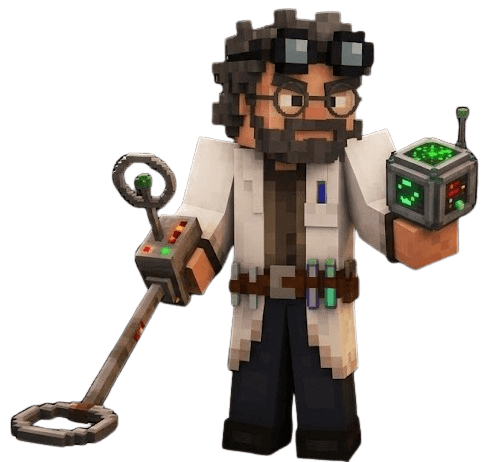
What is a Minecraft Ore Finder? An Ore Finder for Minecraft is a seed-mapping coordinate calculator that instantly locates the exact X, Y, and Z block coordinates of rare resources like Diamonds and Ancient Debris. Unlike standard chunk viewers, it sorts nearby ore clusters by distance and estimated vein size for both Java and Bedrock editions (1.18 to 1.26+), allowing players to mine with absolute mathematical precision.
Listen up, miners. You are probably reading this because you have been strip-mining deepslate for two hours at the wrong altitude, burning through iron pickaxes, and all you have to show for it is gravel and frustration. I am Dr. Silex von Carbono, and in this laboratory, we do not guess. We use algorithmic precision to find exactly where the world generation placed your loot.
Stop wandering blindly through caves. Getting your exact coordinates takes less than ten seconds using our local JavaScript deterministic engine—no downloads required. Here is how you execute a perfect mining operation:
/seed in the chat. For Bedrock Edition (MCPE, Xbox, PS5, Switch), pause the game, go to Settings > Game, and scroll down to find your numeric World Seed.A massive portion of the Minecraft community plays Bedrock Edition on a console or mobile device. You cannot easily install mods or third-party X-Ray texture packs on a PS5 or Xbox without risking a ban or permanently disabling your Survival Achievements.
This web tool is designed as the ultimate second-screen companion for Bedrock players. You can keep your world pristine and cheat-free on your TV, while running this tracker on your phone's browser. It works 100% locally on your device, meaning it calculates chunks instantly without lagging out your game. And if you want the native mobile experience, we have our official iOS Companion App available on the App Store (ID: 6749192274), fully optimized for offline mining runs.
Since the Caves & Cliffs update, the world depth expanded down to Y: -64. The old advice of mining at Y: 12 is entirely obsolete. The generation now uses a triangular distribution model, meaning ores peak at very specific altitudes and taper off the further you move away from them.
| Minecraft Ore | Best Y-Level (Peak) | Dr. Silex's Tactical Mining Notes |
|---|---|---|
| Diamond | Y: -59 |
Strip mine here. Avoid Y: -60 or lower to prevent constantly hitting bedrock blocks that break your mining rhythm. |
| Ancient Debris | Y: 15 |
Netherite is rare. Use the exploding bed tactic or TNT tunneling at Y: 15 in the Nether. Always bring Fire Resistance. |
| Iron | Y: 15 & Y: 232 |
Iron has two peaks. If you are in the mountains, mine high. If underground, stick to Y: 15. |
| Gold | Y: -16 (Badlands: 32+) |
In a standard biome, go deep. But if you find a Badlands (Mesa) biome, gold generates massively anywhere above Y: 32. |
| Emerald | Y: 232 |
Only spawns under mountain biomes. The higher you climb, the more you find. |
| Copper | Y: 48 |
Best found in Dripstone Caves. Bring a Fortune III pickaxe to yield massive amounts of Raw Copper. |
| Coal | Y: 95 |
Coal completely stops generating below Y: 0. Do not look for coal in the deepslate layer; you will not find it. |
| Lapis Lazuli | Y: -1 |
Highly susceptible to air exposure. You must strip mine for it; caving is highly inefficient. |
| Redstone | Y: -59 |
Follows the exact same deep generation curve as Diamonds. You will naturally find plenty while hunting for diamond veins. |
Standard chunk mapping websites (like Chunkbase) are excellent for finding biomes and large structures, but they fail miserably at micro-level resource management. They show you a 16x16 chunk and tell you "there might be a slime chunk here." We don't do "might."
Our algorithm reverse-engineers the pseudo-random number generator (PRNG) of your seed. We output the exact X, Y, and Z coordinate of the block. We calculate the exact distance in meters from your current position, and we automatically apply the 1:8 coordinate conversion ratio if you are tracking Overworld coordinates from inside the Nether.
Have you ever generated a coordinate, dug straight down, and found nothing? Welcome to the "Air Exposure" penalty. When the Minecraft algorithm tries to place a Diamond or Lapis vein, it checks if the block is touching air (like the wall of a cave). If it is, there is a 50% to 70% chance the game will cancel the spawn to keep caves from being too overpowered.
This means if a calculated coordinate lands exactly on the wall of a massive subterranean ravine, the ore might have been deleted by the terrain generator. This is why mathematical strip mining (tunneling through solid rock) always yields more resources than exploring open caves.
Deepslate Emerald is statistically the rarest block in Survival Minecraft. Emeralds only spawn in Mountain biomes (which push generation upwards), but Deepslate only exists below Y: 0. To find this anomaly, our tool searches for the exact mathematical overlap where a mountain biome dips dangerously low into a deepslate cave system.
Similarly, we track the parameters for Giant Ore Veins—massive, snake-like formations of Raw Iron and Raw Copper mixed with Granite and Tuff, which can yield thousands of raw materials from a single strike.
Find the best Minecraft Education Edition maps for class or fun. Download free official STEM, history, and .mcworld worlds plus a 3-step import guide.
Want to play Minecraft Nintendo Switch 2 player split-screen? Fix controller issues, play offline without NSO, and set up Switch 2 co-op in 2 minutes.
The Sift is officially the new Minecraft dimension! See the 2027 Vanilla release date, how to play now in Dungeons II, portal facts, mobs & biomes.
Looking for Dungeons 2 Minecraft? Get the full Minecraft Dungeons II release guide, Game Pass info, pricing, plus our honest verdict on the RAD 2 modpack.
Hunting all 6 Domino
Wondering how much dedicated RAM for a Minecraft server you really need? Get honest 2026 specs for Vanilla, Paper & Modpacks + our free RAM calculator.
Looking for an active server? Prop Hunt Minecraft IPs for Java & Bedrock tested in 2026. Copy working addresses, ports, and skip dead lobbies today.
Learn how to make a brick block on Minecraft fast. Get the 2x2 recipe, dodge the Terracotta trap, and farm unlimited bricks in Java & Bedrock.
Master planting saplings in Minecraft! Get exact light levels, spacing charts for every tree (including Pale Oak), cave farm setups, and fast growth tips.
Minecraft uses your numerical world seed to mathematically generate terrain through a predictable algorithm. By inputting your seed and version into our calculator, the script mathematically replicates this generation process locally in your browser, revealing the exact X, Y, and Z coordinates of ore clusters without pinging remote servers.
Yes. Our tool has dedicated algorithms for Minecraft Bedrock Edition. Because the generation logic differs slightly from Java Edition, you must select "Bedrock" in the settings toggle to ensure the coordinates align perfectly with your console or mobile world.
For Minecraft 1.18 through 1.26+, the absolute best Y-level for Diamonds is Y: -59. For Ancient Debris (Netherite), the maximum concentration is found at Y: 15 in the Nether. Always strip mine at these coordinates to avoid the air exposure penalty.
In Java Edition, type /seed in the chat window; this command works even if cheats are disabled. In Bedrock Edition, pause the game, navigate to Settings, click on Game, and scroll down to the "Seed" field. Viewing your seed does not disable achievements.
Deepslate Emerald Ore only generates below Y: 0 exclusively underneath Mountain biomes. Huge Copper veins generate around Y: 0 mixed with Granite, while Huge Iron veins generate around Y: -16 mixed with Tuff. You can select these specific targets in our interactive calculator.
If a vein is missing, it was likely overridden by the "Air Exposure" penalty or a structural generation (like a Mineshaft, Geode, or Ancient City) cutting through the block. The game sometimes aborts placing an ore if the block is exposed to open cave air.